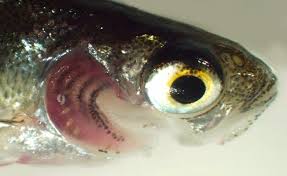
About this condition
Ergasilus briani is a tiny parasitic crustacean that sticks to a fish’s gills, a bit like a microscopic crab. It irritates the gills and makes it harder for fish to breathe. Heavy infections can stress the fish and slow them down.
What is Ergasilus briani?
Ergasilus briani is a tiny parasite — a little crustacean like a microscopic shrimp — that lives on the gills of freshwater fish.
It’s only about 1mm long, but it has two sharp antennae it uses to hook onto a fish.
It can infect lots of different fish species, especially small fish, and only the adult females attach to fish. All the other stages just float around in the water.
What does it do to fish?
Once E. briani hooks onto a fish’s gills, it starts feeding using its tiny, tooth-like mouthparts.
It feeds on:
- Mucus
- Blood
- Gill tissue
This can cause problems because the gills are how fish breathe.
When lots of parasites are attached:
- Fish struggle to get enough oxygen
- They become stressed more easily
- They grow more slowly
- Young fish might even die if they’re heavily infected
In some studies, over 90% of small bream (fry) were found with this parasite, which can seriously affect survival.
What damage does it cause?
Because this parasite hooks deep into the gill tissue, it can cause:
- Inflammation and irritation
- Dead patches of tissue
- Burst or squashed blood vessels
This makes the gills less able to work properly, so fish can’t breathe as well as they should.
Which fish are affected most?
Ergasilus briani can infect many freshwater fish, but it especially likes:
- Bream
- Tench
- Crucian carp
It prefers fish under 10 cm long, but bigger fish can still carry it — and can accidentally move the parasite to new waters.
Infections are usually worst in summer and late autumn.
The life cycle — how the parasite spreads
E. briani has several stages before becoming a parasite.
Simple version of the life cycle:
- Eggs hatch into tiny larvae that float freely in the water
- These stages can live for weeks and feed on algae
- When they grow into adult females, they attach to the gills of fish
- Adult females can live for nearly a year and survive the winter
- They release long strings of eggs from their bodies
- Warmer temperatures in spring start the cycle again
Once the parasite is in a fishery, there can be millions of these free-living stages in the water.
⭐ Protecting a Fishery from Ergasilus briani
Because this parasite causes serious problems, fish can’t be moved from infected waters.
There’s no chemical treatment that kills all stages of the parasite, so managing the fishery is the best defence.
Here’s what helps:
1. Reduce the number of small fish
Small fish are the most at risk.
Having too many of them makes it easy for the parasite to spread.
2. Keep fish numbers low overall
The fewer fish in the lake or pond, the harder it is for the parasite to find a new host.
This helps reduce infection levels over time.
3. Look after water quality
Fish with damaged gills find it harder to breathe, especially when:
- Oxygen levels are low
- Water temperatures change quickly
- Water becomes dirty or polluted
Regularly checking water quality helps infected fish cope much better.
4. Stop the parasite spreading further
Because the free-living stages float everywhere, they can travel on:
- Water
- Plants
- Nets, mats, and buckets
Good biosecurity is essential:
- Clean and dry equipment
- Don’t move fish without checks
- Be careful with water transfers
Can it be removed completely?
The only way to completely wipe out the parasite is to:
- Remove all fish
- Drain the water
- Lime the lake
But this is expensive and not practical for most fisheries.
Good ongoing fishery management is a much better long-term approach.