About this condition
Schyzocotyle acheilognathi, or the Asian tapeworm, is a long ribbon-like parasite that lives inside the intestines of carp and other freshwater fish. It attaches to the gut wall and steals the fish’s food, which can slow their growth, weaken them, and even block the intestine completely. Young fish are especially at risk, and heavy infections can cause serious health problems or death, so good fishery management and biosecurity are important to stop it spreading.
What is Schyzocotyle acheilognathi?
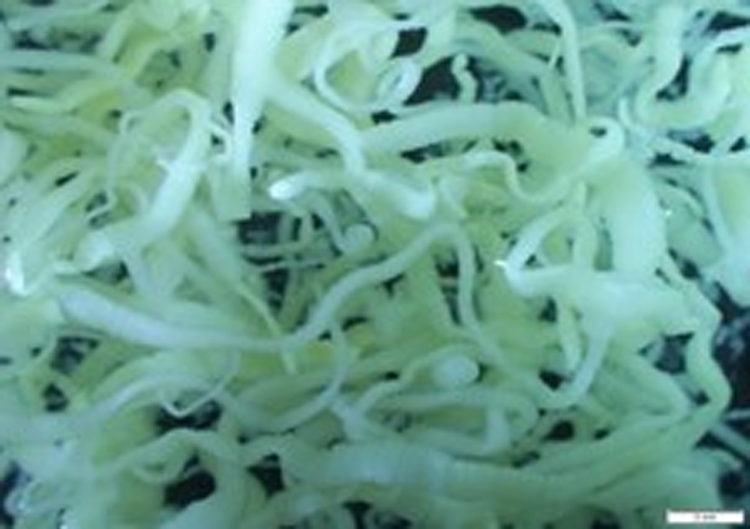
Schyzocotyle acheilognathi — often called the Asian tapeworm — is a long, flat parasite that lives inside the intestine of fish.
It has a ribbon-like body made of segments and a heart-shaped head that helps it attach firmly to the gut wall.
It often infects fish in the carp family, especially:
- Common carp
- Grass carp
- Crucian carp
This parasite originally came from Asia and spread around the world through the movement and trade of carp.
What does the Asian tapeworm do to fish?
This parasite harms fish in a few major ways:
1. It attaches to the intestine wall
The tapeworm uses special grooves on its head to grip the gut tightly, which crushes and irritates the intestine.
2. It can block the gut completely
Some worms grow up to 50cm long.
If they attach near the top of the intestine, they can stop food from passing through at all.
3. It steals the fish’s nutrients
Instead of letting the fish absorb the goodness from its food, the tapeworm absorbs it for itself.
This causes:
- Poor growth
- Thin, weak fish
- Loss of condition
- Slowed development
- Even death in small fish (sometimes nearly 100% mortality in fry)
Small fish are the most at risk because their intestines are tiny — even one worm can cause major problems.
What damage does it cause inside the fish?
Heavy infections can be very serious. The intestine may become:
- Swollen
- Inflamed
- Stretched and thin
- Bleeding internally
- Damaged to the point it can rupture
Because the fish loses nutrients, their liver also suffers, reducing the fish’s energy reserves.
Infected fish often become:
- Very thin
- Sluggish
- Weak
- Less able to survive winter
⭐ Life Cycle — How the Tapeworm Spreads
The Asian tapeworm has a two-host life cycle:
1. The eggs leave the fish
The adult tapeworm lives inside the fish and releases thousands of eggs every day into the water.
2. Copepods eat the larvae
The small parasite larvae that hatch from the eggs are eaten by copepods (tiny water creatures).
3. Fish become infected
Fish get the parasite by eating infected copepods.
Once inside the fish, the parasite grows into an adult and the cycle repeats.
Temperature matters
The life cycle is faster in warm water:
- As short as 1 month in warm temperatures
- Up to 1 year in cold conditions
This means infections often worsen in summer and early autumn.
⭐ Which fish are most at risk?
Although it can infect many species, the Asian tapeworm prefers carp species.
Fish under 10 cm are at the highest risk because they are more likely to feed on copepods — and their small guts block easily.
However, larger carp can still become infected and can spread the parasite to new waters.
⭐ Protecting a Fishery from the Asian Tapeworm
Because this tapeworm causes serious disease, infected fish cannot be moved.
To prevent the parasite entering a fishery:
- Only buy fish from trusted suppliers
- Always get fish health checked before stocking
- Keep strong biosecurity
- Avoid moving water, plants, or muddy equipment between waters
Millions of parasite larvae can be present in infected waters, and the parasite can be spread simply by contaminated water or gear.
⭐ What to do if the parasite is already in a fishery
There is no effective chemical treatment to remove the Asian tapeworm from a waterbody.
The only guaranteed method is:
- Remove all fish
- Drain the fishery
- Lime the lake bed
This is expensive, difficult, and usually not practical.
Best management actions instead:
- Carefully manage stock levels
- Remove obviously sick or severely infected fish
- Monitor water quality
- Avoid overstocking, which increases infection pressure
Good fishery management is the most effective long-term tool to reduce its impact.