About this condition
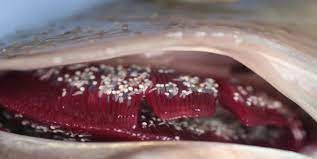
Ergasilus sieboldi, also known as the gill maggot, is a tiny parasite that attaches to the gills of freshwater fish. The adult females have long white egg sacs that trail behind them, making them easy to spot. They feed on the fish’s gill tissue, blood and mucus, which makes it harder for the fish to breathe and stay healthy. Heavy infections can cause fish to become tired, lose weight, grow slowly, or even die — especially in warm weather. This parasite can spread quickly through a fishery, so good fishery management and strong biosecurity are really important to keep fish safe.
What is Ergasilus sieboldi?
Ergasilus sieboldi is a tiny parasitic crustacean — a bit like a microscopic shrimp — that lives on the gills of freshwater fish.
Anglers often call it the “gill maggot” because the adult females have long white egg sacs that trail behind them, making them look like tiny maggots.
They are over 1mm long, so you can sometimes see them without a microscope.
Only the adult females attach to fish. All the younger stages float around freely in the water.
What does Ergasilus sieboldi do to fish?
These parasites use their two sharp antennae to stab deep into the gill tissue and hang on tightly.
Once attached, they feed on:
- Blood
- Mucus
- Gill cells
They scrape this food from the gills using tiny serrated (saw-like) mouthparts.
This causes major problems for fish:
- They can struggle to breathe
- Their gills can’t work properly
- They lose body condition
- They grow more slowly
- They become sluggish and tired
- They are more likely to catch other diseases
- They cope badly with hot weather or low oxygen
Heavy infections can even cause fish deaths, especially in species like tench, bream, and trout.
What damage does it cause?
The parasite causes a lot of irritation and injury, including:
- Deformed gill filaments
- Burst blood vessels
- Dead patches of tissue
- Erosion of the delicate gill surface
- Swelling and cell overgrowth
- Blocked blood flow
When infections are bad, the gills lose their shape and can’t pass oxygen into the blood properly — meaning fish can suffocate even in good water.
Which fish are affected most?
Although it can infect many freshwater fish, some species are more at risk:
- Tench
- Bream
- Pike
- Brown trout
- Rainbow trout
Unlike some other parasites that prefer tiny fish, E. sieboldi actually prefers larger fish (often over 15cm).
It mainly lives on the gills, but can sometimes also be found on the fins, body, or even inside the nostrils.
Infections are usually worst in late summer and autumn.
⭐ Life Cycle — How the “Gill Maggot” Spreads
- Eggs hatch into tiny larvae that float freely in the water
- These stages feed on algae and grow
- After a few weeks, they become adults
- Adult females attach to the gills of fish
- Each female can lay 3–5 egg batches per year
- Each batch contains around 220 eggs
- They live for nearly one year and survive through winter
Temperature matters:
- Reproduction starts around 8°C (spring)
- Development takes 10 weeks in cool water
- But only 22 days in warm conditions
- Infections increase through spring → summer → autumn
Once a fishery is infected, there can be millions of parasite larvae in the water.
⭐ Protecting a Fishery From Ergasilus sieboldi
Because this parasite causes serious damage, fish moves from infected waters are restricted.
Best ways to stop it spreading
1. Limit fish stocking
Fewer fish moved = fewer chances to spread parasites.
Always get fish health checked before stocking.
2. Keep good biosecurity
The parasite spreads on:
- Infected water
- Plants
- Nets, mats, buckets, and other fishing gear
So always:
- Clean and dry your equipment
- Avoid moving water between venues
- Follow fishery rules on disinfection
⭐ If the parasite is already present
There’s no chemical treatment that works against all stages of this parasite.
The only way to remove it completely is:
- De-stock the water
- Drain it
- Lime the bottom
This is expensive and not realistic for most fisheries.
So instead, good fishery management is key.
⭐ Fishery Management Measures
1. Keep fish numbers low
The more fish in the water, the easier it is for parasites to hop from one fish to another.
Lower stock levels = fewer infections.
2. Manage the types of fish in the lake
Larger species like tench, bream, and trout can help the parasite survive.
Reducing numbers of these species can lower parasite levels over time.
3. Keep water quality high
Fish with gill damage struggle especially when:
- Oxygen is low
- Water is warm
- Water quality changes suddenly
Maintaining good water quality gives infected fish a better chance.
4. Remove obviously sick fish
Fish suffering from gill problems often gather near:
- Inlets
- Faster-flowing water
- The surface
Removing these fish:
- Reduces suffering
- Removes many parasites at once
- Helps monitor infection levels